Toll-Free 1-855-952-6526
 +44 1753 201 201
 61-2-86078986
  + 44 ( 0 ) 7739 716978
 What if exploring India’s most iconic heritage sites didn’t involve crowds, heat, and rushed itineraries—but instead unfolded as a seamless, curated journey combining history, comfort, and refined travel?
The Ajanta and Ellora Caves are among India’s most extraordinary UNESCO World Heritage Sites. Yet for many travellers, visiting them independently can feel overwhelming. The scale is vast, the terrain demanding, and without expert guidance, the experience risks becoming fragmented rather than meaningful.
A more considered approach transforms this journey entirely. When visited as part of a structured itinerary—especially within a luxury rail experience—these ancient monuments reveal themselves with clarity, depth, and purpose.
👉 Explore curated journeys including these destinations:
https://www.deccanodyssey.co.uk
Ajanta and Ellora Caves: India’s Timeless Stone Heritage
Located in the state of Maharashtra near Aurangabad, the Ajanta and Ellora Caves represent over a millennium of artistic, religious, and architectural evolution.
Together, they showcase:
- Buddhist monastic caves and paintings
- Hindu temple architecture carved from rock
- Jain artistic traditions and intricate detailing
This rare coexistence of faiths makes the site one of the most significant cultural landmarks in India.
Ajanta Caves: A World of Ancient Buddhist Art
The Ajanta Caves date back to between the 2nd century BCE and 5th century CE and are set within a dramatic horseshoe-shaped gorge.
Unlike Ellora, Ajanta was designed as a secluded retreat for Buddhist monks. The atmosphere here is quiet, reflective, and deeply spiritual.
Highlights include:
- Intricate frescoes depicting the life of Buddha
- Detailed carvings and monastic halls
- Iconic figures such as Padmapani and Vajrapani
- Jataka tales illustrating moral and spiritual teachings
Ajanta is often regarded as one of the finest surviving examples of ancient Indian painting and remains a key highlight for travellers interested in India’s cultural heritage tours.
Ellora Caves: A Monumental Fusion of Faiths
Ellora, developed between the 6th and 10th centuries CE, offers a completely different experience.
Spread across 34 caves, Ellora reflects a more public and monumental vision of spirituality. Here, Buddhist, Hindu, and Jain caves stand side by side—demonstrating a remarkable level of religious harmony.
Key highlights include:
- Buddhist monasteries and meditation halls
- Hindu temples with grand sculptural detail
- Jain caves with intricate carvings and symmetry
This diversity makes Ellora one of the most unique architectural sites in the world.
The Kailasa Temple: An Engineering Marvel
The highlight of Ellora is undoubtedly the Kailasa Temple (Cave 16).
Carved entirely from a single rock, this structure is considered one of the greatest engineering achievements in human history.
- Excavated from top to bottom
- Over 200,000 tonnes of rock removed
- Designed to resemble Mount Kailash, the abode of Lord Shiva
Even today, modern engineering struggles to fully explain how such precision and scale were achieved without advanced tools.
Why Visiting Ajanta and Ellora Requires Careful Planning
While the caves are extraordinary, visiting them independently can present challenges:
- Long travel distances between sites
- High temperatures, especially in summer
- Large crowds during peak seasons
- Lack of structured interpretation without guides
For travellers seeking a more refined experience, combining these sites within a curated itinerary ensures a more comfortable and enriching journey.
Experience Ajanta and Ellora with the Deccan Odyssey
One of the most seamless ways to explore these sites is through the Deccan Odyssey luxury train, which includes visits to Ajanta and Ellora as part of its carefully designed itineraries.
👉 Discover journeys:
https://www.deccanodyssey.co.uk
This luxury train offers:
- Air-conditioned comfort throughout the journey
- Guided excursions with expert historians
- Hassle-free transfers and logistics
- Premium accommodation and dining onboard
Rather than navigating the journey independently, travellers can experience these historic sites as part of a well-structured luxury travel itinerary in India.
A Journey Beyond the Caves
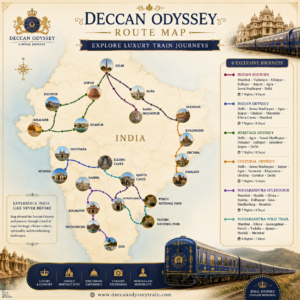
The Deccan Odyssey does not limit itself to Ajanta and Ellora. Its routes often include:
- Mumbai’s cultural highlights
- Rajasthan’s royal cities
- Gujarat’s heritage landscapes
- Wildlife experiences and coastal destinations
👉 View full itineraries:
https://www.deccanodyssey.co.uk
This allows travellers to combine India’s most important cultural landmarks into one cohesive journey.
Why Luxury Travel Enhances the Experience
Visiting Ajanta and Ellora is not just about seeing monuments—it is about understanding them.
A curated luxury journey offers:
- Expert-led guided tours for deeper insight
- Time-efficient travel between destinations
- Comfort in extreme climates
- A balanced pace that avoids fatigue
This approach transforms the experience from sightseeing into meaningful exploration.
Best Time to Visit Ajanta and Ellora
The ideal time to visit is between October and March, when temperatures are more comfortable.
During these months:
- Weather is cooler and more pleasant
- Sightseeing is more enjoyable
- Landscapes are at their best
Final Thoughts
The Ajanta and Ellora Caves are not just historical sites—they are living expressions of India’s artistic and spiritual heritage.
When experienced thoughtfully, they offer:
- A journey through over 1,000 years of history
- A deeper understanding of India’s cultural evolution
- A rare connection between art, faith, and architecture
By combining these sites with a structured luxury journey such as the Deccan Odyssey, travellers can experience them in the most seamless and enriching way possible.
👉 Begin your journey:
https://www.deccanodyssey.co.uk